Identify up to five plausible candidates from the public record.
How it works
Discovery first. Evidence before assertion.
Evidence Axis does not assume the names already on your radar are the whole market. We discover, verify, classify and then interpret — keeping material conclusions traceable to the evidence behind them.
DISCOVERY BEFORE DEEP DIVE
A competitor list is an input, not the answer.
Whether the work begins through a complimentary request, a proactive Gift or a paid engagement, discovery comes before the final shortlist. A scan-derived competitor must be validated before it enters the deep dive.
Require at least two independent non-vendor sources for a scan-derived shortlist competitor.
Investigate product, pricing, positioning, claims and recent moves only after validation.
“No additional competitor verified within scan scope” is a valid outcome.
The core distinction
Three states, kept separate on purpose.
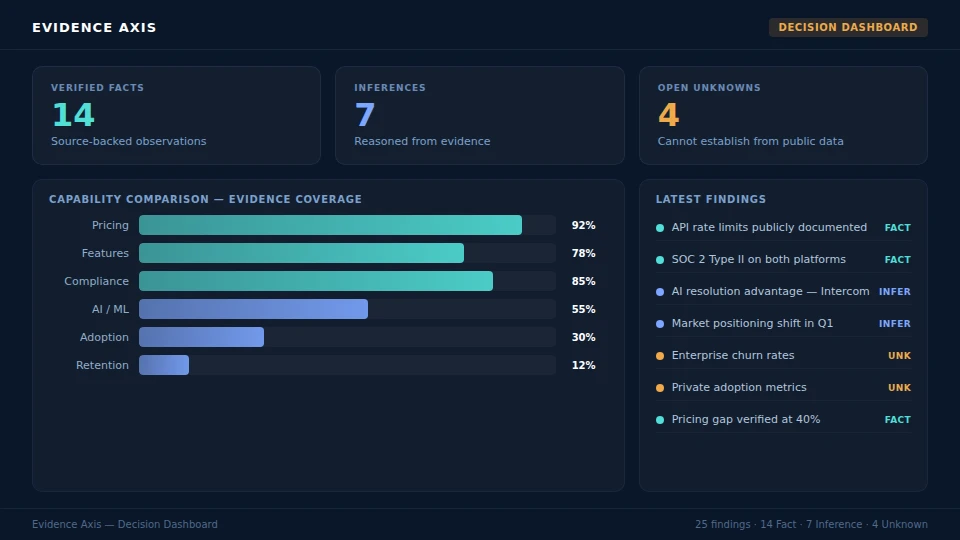
Most competitor work blurs what is proven with what is guessed. Evidence Axis keeps them apart — in the analysis and in the final deliverable.
A statement directly supported by identifiable evidence that was opened and checked. Recorded with its source and review date.
What the checked source directly supports, stated without adding interpretation.
A reasoned conclusion drawn from disclosed evidence. Clearly separated from verified fact, with the reasoning visible.
What the evidence suggests, labeled as interpretation rather than proof.
Something the available evidence cannot responsibly establish. Named, not guessed at or quietly filled in.
The questions we could not close, so you know where certainty ends.
TRACEABLE REASONING
Walk any conclusion back to its source.
Nothing should enter a brief as a bare assertion. The path stays visible from public source, to observation, to evidence state, to the implication it supports.
Select any conclusion to trace its provenance back to a source.
- SRCSource
A checked source: primary company page, documentation, changelog or credible independent evidence.
- OBSObservation
What the source plainly shows, recorded before interpretation.
- FACTFact
A statement the checked evidence directly supports.
- INFERInference
A reasoned conclusion drawn from disclosed facts, labeled as interpretation.
- UNKUnknown
What the evidence cannot establish, named rather than guessed.
- DECDecision implication
What the evidence means for attention, priority or the decision in front of the team.
THE SEQUENCE
From discovery to executive intelligence.
AI can accelerate discovery and organization. Human review still controls what enters the evidence record and what can responsibly reach a decision-maker.
- 01
Scan the competitive set
We do not assume the names already on your radar are the whole market. We identify plausible candidates from the public record before choosing where the deep dive belongs.
- 02
Validate scan-derived competitors
A competitor surfaced by the scan needs at least two independent non-vendor sources confirming that it belongs in the same competitive set before it enters the shortlist.
- 03
Set the research boundary
We define what needs to be investigated and what the public record can responsibly support. Paid engagements also bring in the client’s decision context.
- 04
Open, verify and classify sources
We work through primary pages, documentation, pricing, changelogs and strong independent sources. Search snippets are not verification, and vendor comparison pages are not treated as neutral evidence.
- 05
Extract Fact, Inference and Unknown
Each material statement is classified. Conflicts stay visible, missing evidence remains Unknown, and analytical judgment is labeled as inference.
- 06
Build the executive intelligence
We turn the verified record into an Executive Intelligence Deck and Evidence Appendix, showing what matters, why it may matter, and the source trail behind it.
- 07
Add decision context when engaged
In a paid Decision Sprint, the verified market evidence is combined with the company’s real decision, constraints and internal context to determine what response should follow.
Not every public page has the same evidentiary weight.
Primary company source
Product pages, pricing, documentation, changelogs and the company’s own public claims.
Independent press / credible third party
Triangulation, competitive-set validation and context independent of the vendor.
Data aggregator
A supporting lead when provenance and freshness are understood; not automatically primary evidence.
Vendor-authored comparison
Useful for the vendor’s own positioning — not neutral proof about the rival.
AI-targeted vendor content
Explicitly classified; material claims need corroboration where feasible or remain vendor claim / Unknown.
Discovery-only lead
Useful for finding where to look next. It does not enter the final evidence trail until verified.
THE SAFEGUARDS
The details that keep intelligence honest.
Boundary first
We state what the research can and cannot support before confidence starts to grow.
Open the source
Search snippets and generated summaries can lead us somewhere; they do not count as verification.
Record the date
Material observations keep the date they were checked because public information changes.
Preserve conflicts
When credible sources disagree, the contradiction remains visible instead of being cleaned up.
Unknown stays Unknown
Missing evidence is not replaced with a plausible guess.
Trace the conclusion
The final implication can be walked back to the observation, evidence state and source behind it.
Start with the work — or the decision
See the method applied to your company.
Request a complimentary company-specific brief using a verified work email, or bring a competitive decision that already needs deeper support.
hello@evidenceaxis.com